A Comparative Analysis of Generalized Thermoelastic Theories in Seismic Wave Propagation
Sumit Mahiya* and Ravinder Kumar
Department of Mathematics, University Institute of Sciences, Chandigarh University, Mohali-140413, Punjab, India
E-mail: mahiyasumit@gmail.com; ravinderpoonia25@gmail.com
*Corresponding Author
Received 09 April 2025; Accepted 13 July 2026
Abstract
Seismic wave propagation is defined as the framework of classical elasticity in which thermal effects are neglected. Although, under high frequency dynamic loading and deep Earth conditions mechanical deformation and temperature variations become strongly coupled for advanced thermoelastic formulation. The development of thermoelastic theories applied to seismic wave propagation beginning with classical thermoelasticity and extending through generalized models includes the Lord-Shulman (LS), Green-Lindsay (GL) and Green-Naghdi (GN) theories. The emphasis is placed on the finite speed of thermal wave propagation, thermal relaxation mechanism and their influence on dispersion, attenuation and wave characteristics. The behavior of body and surface waves is analyzed within homogeneous, layered, anisotropic and pre-stressed media. This study suggests that thermoelastic coupling may contribute intrinsic seismic attenuation significantly with high-frequency and high-temperature geological environment. This provides a unified theoretical basis for improved seismic modeling, deep Earth investigation and hazard assessment.
Keywords: Seismology, wave propagation, generalized thermoelasticity, Lord-Shulman theory, Green-Lindsay theory, Green-Naghdi theory.
1 Introduction
The science that studies earthquakes is known as ‘seismology’. Seismology [1] word is derived from Greek words ‘Seismos’ meaning ‘Earthquake’ and ‘Logos’ which means ‘Science’. It is a major branch of geophysics that investigates the origin, propagation and effects of seismic waves generated by earthquake, volcanic activities, landslide, explosions, etc. Seismology plays a crucial role in understanding mechanism of earthquake generation, imaging subsurface structures and also for reducing seismic risk by hazard assessment and earlier warning systems. Seismology’s importance increases significantly due to rapid urbanization, critical infrastructure development and needs for disaster preparedness in earthquake prone regions. Earthquake is one of the most destructive natural hazards. Studying physical mechanism and forecasting its impact is essential for minimizing casualties and economic losses. Seismology supports these goals by providing tools to analyze seismic events, map active faults, estimate earthquake magnitude and evaluate seismic risk. The introduction to seismology and related terms are briefly explained by Shearer [2].
Seismology is classified mainly into three categories:
(i) Observational seismology: The part of seismology record earthquakes, studies the effects, understands the source of generation, size and components of an earthquake.
(ii) Engineering seismology: This part focuses on identifying the risks and danger due to seismic event by designing a structure that withstand the stress caused by ground movement due to earthquake.
(iii) Physical seismology: This part focuses on the physical attributes of the seismic source and also internal structure of the Earth.
Elastic rebound theory explains that earthquake occurs by the sudden shaking of the Earth’s surface which is caused by the rapid release of strain energy stored within the Earth’s lithosphere [3]. When stress exceeds the fault strength, rupture initiates and propagates by generating seismic waves. The immense amount of released energy travels in all directions when seismic waves propagate through the Earth’s interior and also along its surface. The point of an earthquake from where energy releases is called ‘focus’ and point on the Earth’s surface directly above focus is ‘epicenter’. Most of the earthquakes occur due to slip along geological faults resulting tectonic plate movements, but they may also occur by volcanic or human activities.
Types of earthquake based on its occurrence is mainly of four types:
(i) Tectonic earthquake: This results from sudden fault slip due to accumulated elastic strain associated with interactions of lithospheric plate.
(ii) Volcanic earthquake: This is caused by magma intrusion, pressure variations or eruptive processes within volcanic systems.
(iii) Collapse earthquake: This type is caused by structural failure or subsidence within underground cavities.
(iv) Induced earthquake: This is an anthropogenic seismic event induced by activities such as fluid injection, reservoir loading and mining operations.
Types of earthquake based on focal depth is mainly of three types:
(i) Shallow focus earthquake: It is most destructive occurs within the crust (0–70 km).
(ii) Intermediate focus earthquake: This occurs in subduction zones (70–300 km).
(iii) Deep focus earthquake: This occurs within subducting slabs (300–700 km).
1.1 Early Conceptual Foundation
The origin of seismology can be traced to early mechanical detection attempts, most notably the seismoscope developed by Zhang Heng in 132 CE. This innovation constituted a crucial shift to the use of empirical observance of earthquakes. Classical philosophical approaches including those being propagated by Aristotle, reformulated seismic events based on the concepts of nature opposed to the concepts of big concurrently occurring natural events and motion events as solely supernatural in nature influencing scientific investigation in an early foundation.
A turning point was made after the earthquake of 1755 in Lisbon, as the damage and intensity surveys were done in Europe in systematic manner. Researcher Michell came up with the idea that the earthquakes travel in the form of waves in the elastic media formulating an insight which became a predecessor to the modern wave theory and the formulations based on elasticity.
1.2 Instrumental Seismology and Wave Theory
In 1880s, Milne [4] invented a useful seismograph with Gray and Ewing in Japan. This device helped to make a continuous record of seismic movements and opened global seismographic systems. Thus, at the end of the nineteenth century instrumental seismology formally appeared.
The mathematics that contributed to the understanding of seismic waves propagation has its basis on elastic theory and the Navier-Cauchy equations. Surface wave theory was formalized by Love and propagation of such waves through elastic half-spaces was explained by Rayleigh.
1.3 Discovery from Internal Structure of the Earth
Another breakthrough in seismology was the discovery of the core of the earth by Oldham [5], having conducted an examination on both S awareness and P shadows. This piece of work showed that seismic waves are used as probes of interiors of the planets. His discovery of the inner core led to the refinement and his explanation of the anomalous P wave arrivals provided good firm evidence of having a solid inner core entrenched in a fluidic outer core [6].
The standardized models of velocity structure of the Earth were also developed by Jeffreys and Bullen [7], thus formalizing the travel time curves and making the inversion of their Earth system through quantitative approaches possible. These designs formed the basis of modern seismic tomography.
1.4 Modern Computational and Imaging Advances
The development of computers has caused a revolution in both the fields of computation and imaging. In modern computational and imaging advances it brought revolution to both computation and imaging disciplines.
A methodological revolution has been experienced in the field in the past decades due to the use of digital instrumentation and the rising capacities of computation. In seismic tomography, inversion based insights into mantle heterogeneity were introduced by Aki [8] and furthered by Tarantola [9] by using full waveforms instead of just the travel times.
The next revolution in crustal imaging was ambient-noise, invented by Shapiro and Campillo [10] which isolated the functions of Green out of the back seismic noise. Modern broadband channels currently support real time earthquake early warning system and give a probabilistic platform to evaluate seismic hazards.
Generalized thermoelastic theories, such as LS, GL and GN, have also been developed independently within the framework of the continuum thermoelasticity, however a multicalibrated survey of these theories to the context of seismic wave propagation does not exist. They are commonly discussed in isolation in the existing literature, focusing either on the mathematical structure or discrete wave problems and without a synthesized framework of comparison. The gap needed to be bridged is strong in search for synthesis of their governing equations, thermodynamic underpinnings, relaxation processes and consequences on seismic body and surface waves in homogeneous, layered, anisotropic and pre strained geological environment. And this diversity of fundamental analysis of finite thermal wave speed, relaxation time structuring, entropy consistency and dissipation properties between these derived theories is obscured by the absence of consolidated analyzed intellectual property. The comparative evaluation of their effect on dispersion relations, intrinsic attenuation and strength of thermomechanical coupling between seismic frequency regimes is no longer well documented. A critical and comparative synthesis, which should bring all these generalized thermo elastic formulations together into a consistent seismic modeling paradigm which would demystify their theoretical relationships with each other and to which their geophysical usefulness could be applied in practice, is therefore essential.
Despite significant advances in thermoelastic wave propagation theory, the application of generalized thermoelastic formulations to seismic wave analysis remains conceptually fragmented and insufficiently validated. Existing studies predominantly concentrate on isolated mathematical developments, specific boundary value formulations or particular wave propagation configurations without establishing a comparative understanding of how thermoelastic theories behave under seismologically relevant conditions. The major unresolved issue is absence of systematic evaluation of the comparative predictive behavior of generalized thermoelastic models with respect to key seismic observables such as attenuation, dispersion, phase velocity variation, thermo mechanical coupling intensity, and energy dissipation mechanisms. Although the LS, GL and GN theories are frequently cited as generalized alternatives to classical thermoelasticity, their relative advantages, physical limitations and realistic seismic applications remain insufficiently clarified.
Therefore, the present study addresses these unresolved deficiencies through a structured comparative assessment of generalized thermoelastic theories in seismic wave propagation with emphasis on their governing assumptions, thermodynamic consistency, physical realism and applicability to advanced geophysical wave modeling. Based on the limitations identified in existing thermoelastic seismic wave literature, the present study is guided by the principal objectives of the present investigation is to develop a comprehensive and unified theoretical framework for analyzing seismic wave propagation within the context of generalized thermoelasticity. This seeks to systematically compare the major thermoelastic models like CTE, LS, GL and GN theories by examining their underlying assumptions, mathematical formulations and associated physical interpretations. Particular emphasis is placed on understanding how thermoelastic coupling influences the propagation behavior, attenuation characteristics, and dispersion of both body and surface seismic waves in thermoelastic media. Furthermore, this research aims to assess the comparative suitability, predictive capability and practical relevance of these thermoelastic formulations for realistic seismic and geophysical applications where thermal effects and mechanical disturbances interact significantly. In addition, the study identifies the existing limitations of generalized thermoelastic wave models and highlights potential directions for future advancements particularly in the development of more accurate and application oriented seismic analysis frameworks for complex geological environments.
2 Seismic Waves
Seismic waves are a type of perturbation of elastic character. These are sudden redistribution of the stress and strain energies in geological materials that propagate in the Earth. They are solutions to the equation of motion in deformable, isotropic or anisotropic media which are governed by elastodynamic equations. Seismic waves are transmitted as mechanical waves which do not involve the transfer of matter permanently, although a case of irreversible deformation near the source of the seismic wave may occur. In the event tectonic stress is built up along a fault because of the movement of plates, the rock will execute elastic responses up to its failure level. When the rupture occurs the previously accumulated elastic strain energy is suddenly emitted and shines away in seismic waves. The conventional explanation of this process is the elastic rebound theory and it was firstly proposed by Reid [11]. The resultant wavefield includes complexes of compressional, shear and surface wave motions that are controlled by source mechanics and the medium properties. Seismic waves are classified as Body waves and Surface waves.
2.1 Body Waves
Body waves move through the interior layers of the Earth. These are the fastest type of seismic waves and are usually the first to be recorded by seismographs after an earthquake. These are classified into two types as: Primary and Secondary waves.
Primary waves (P waves) are commonly known as compressional waves and the fastest type of seismic body waves generated during an earthquake. These are longitudinal in nature, i.e. particle motion occur parallel to the direction of propagation of wave producing alternating zones of compression and rarefaction within the medium. Their velocity varies depending upon the elastic properties and density of the medium ranging from about 5–8 km/s in the Earth’s crust up to 13–14 km/s in deeper mantle regions.
Their velocity is expressed as
| (1) |
where represents the bulk modulus, the shear modulus and the density of the material.
Secondary waves (S waves) are commonly known as shear waves. These propagates through interior of Earth and reach at seismic station after P waves. They are characterized by transverse motion of particle that the particles of the medium oscillates perpendicular to the direction of propagation of wave and velocity depends upon the shear modulus.
Density of the material and is mathematically expressed as
| (2) |
2.2 Surface Waves
Surface waves travel along the Earth’s surface. These waves are slower than body waves but cause the most destruction during an earthquake. These are classified into three parts as: Love, Rayleigh and Stoneley waves.
Love waves are characterized by horizontally polarized shear motion in which the ground particles oscillate side to side in the direction perpendicular to the direction of wave propagation. Unlike body wave that travels through the Earth’s interior, Love waves are confined with layered media typically propagates along the interface between a low velocity surface layer and a higher velocity underlying half space. Love waves frequently produce intense horizontal ground shaking which can result in significant structural damage during earthquake especially to buildings with poor lateral resistance.
Rayleigh waves are dispersive surface waves generated by seismic sources which propagates along the elastic half space of the free surface. These waves are characterized by retrograde elliptical motion of particle in which ground particles move in elliptical paths opposite to the direction of propagation of wave producing a rolling motion like ocean waves to the Earth’s surface. This motion results from a combination of compressional and vertical shear displacement causing particles to move simultaneously in horizontal and vertical direction while the amplitude decreases with depth. They are highly dispersive and their velocity varies with frequency due to the layered and heterogeneous nature of the Earth allowing different wavelength components to travel at different speeds.
Stoneley wave is a type of seismic interface wave that propagates along a boundary between two different elastic media, most commonly at a solid-fluid interface e.g. rock-water or rock-drilling mud interface in a borehole. They are guided waves and energy is concentrated near the interfaces and decays exponentially away from it into the adjoining both medias. The particle motion associated with a guided interface wave is typically elliptical in nature with particles moving in closed elliptical paths close to the boundary. Sometimes these are referred as generalized Rayleigh waves at interfaces.
2.3 Propagation of Seismic Waves
Seismic wave propagation [12, 13] is traditionally modelled using classical elasticity where temperature effects are neglected. During seismic events in deep crustal and geothermal regions mechanical deformation and temperature variations are strongly coupled. Rapid compression and shear deformation produce localized heating which in turn modifies stress distribution and wave characteristics. This mutual interaction between mechanical and thermal fields forms the basis of thermoelasticity.
Classical thermoelastic theory assumes Fourier heat conduction implying infinite thermal signal speed at seismic frequency mainly in high frequency wave propagation and deep Earth conditions. This assumption became physically unrealistic and motivated the development of generalized theories of thermoelasticity that introduce both thermal relaxation time and hyperbolic heat conduction law. The refined models allows more accurate prediction for dispersion, attenuation and thermal damping into seismic waves.
The propagation of waves is mathematically described by the equations derived from Newton’s second law of motion for a deformable continuum
| (3) |
and in absence of body forces
| (4) |
Stress-strain relationships (Hooke’s law) for small deformation:
| (5) |
In the isotropic homogeneous elastic medium two fundamental wave types arise from the decomposition of motion into a Irrotational components (P waves) and Rotational components (S waves). The velocity of these waves are controlled by the elastic moduli and density of that medium, where P wave’s velocity depends on bulk modulus, shear modulus and density and S wave’s velocity depends only on shear modulus and density. Because fluids lack shear rigidity (), S waves cannot propagate through them. For example, Sharma and Kumar [14] investigated Love type surface wave behavior in thermoelastic layered environments with interface irregularity demonstrating the influence of thermoelastic coupling on dispersion characteristics. Similarly, Saini and Kumar [15] analyzed Love wave propagation in isotropic thermoelastic layered structures with rigid boundary effects highlighting the sensitivity of wave response to thermo mechanical interactions. More recent investigations in advanced thermoelastic wave modeling further indicate that generalized thermoelastic formulations play an increasingly important role in realistic seismic and geophysical wave analysis. However, these studies largely remain configuration specific and a systematic comparative synthesis of generalized thermoelastic theories for seismic wave propagation remains limited. This principle provides us key evidence that the nature of the Earth’s outer core is liquidic as demonstrated by observations of S wave shadow zones by Beno Gutenberg [16].
3 Thermoelasticity
Thermoelasticity is the theory that describes the coupled interaction between mechanical deformation and temperature variation in elastic solids. Many physical systems in geophysics, seismic wave propagation, aerospace structures, high temperature mechanical and thermal engineering fields are intrinsically linked. The mathematical formulation combines the equations of elasticity with heat conduction [17] and thermodynamic principles.
In linear thermoelasticity small deformations and small temperature variations from a reference state is assumed. The resulting theory gives us a system of coupled partial differential equation’s governing displacement and temperature field. Thermoelasticity and related concepts were first systematically discussed by Biot [18].
3.1 Thermoelastic Wave Propagation
Assume harmonic solutions:
| (6) |
Substitution yields dispersion relations for Longitudinal (P) and Shear (S) waves.
Longitudinal Wave Speed (without coupling):
| (7) |
Shear Wave Speed:
| (8) |
Thermoelastic coupling modifies longitudinal wave propagation by introducing attenuation and dispersion.
3.2 Development of Thermoelastic Theories
The development states a progressive refinement of coupling between the thermal and mechanical fields in deformable solids. In the seismic wave propagation rapid stress variation generates temperature perturbation and conversely thermal gradient influences stress distribution. Classically the elasticity neglects a thermal effect while classical thermoelasticity assumes that the instantaneous heat conduction and both insufficient for modeling high frequency earthquake dynamics. This is a theoretical evolution from classical formulation to generalized models which can describe thermal waves of finite speed, relaxation effects and realistic seismic attenuation.
Classical Thermoelasticity (CTE) represents the earliest and most fundamental theoretical framework describing the coupling between mechanical deformation and temperature variations in elastic solids. The theory was primarily developed during the late 19th and early 20th centuries through the works of pioneers such as Neumann, Clebsch, Kelvin and later formalized within continuum mechanics by Truesdell. CTE provides the foundation upon which modern generalized thermoelastic theories were later built. Classical thermoelasticity is based on the framework of linear elasticity coupled with Fourier heat conduction.
By making use of Fourier’s law
| (9) |
the, classical heat conduction equation:
| (10) |
The primary assumptions are small deformations and linear strain displacement relations.
The strain tensor is defined as
| (11) |
where and are displacement components.
Linear constitutive behavior i.e. stress is linearly related to strain and temperature change, instantaneous heat propagation.
Heat flux obeys Fourier’s law:
| (12) |
where is thermal conductivity.
Weak thermoelastic coupling implies that temperature variations influence stress through thermal expansion but mechanical deformation has limited feedback on temperature except through volumetric strain. Furthermore, absence of thermal relaxation time states that thermal disturbances propagate with infinite speed due to the parabolic nature of Fourier’s heat equation.
Physically CTE assumes that temperature adjusts instantaneously to mechanical disturbances. This approximation is valid for slow process but becomes questionable under high frequency and short duration phenomena like seismic wave propagation.
3.3 Lord-Shulman Thermoelastic Theory
The LS [19] theory was proposed to overcome the principal deficiency of classical thermoelasticity and the prediction for infinite speed of heat propagation. This theory introduces a single thermal relaxation time by modifying Fourier’s law and transforming the heat equation from parabolic to hyperbolic type. This modification ensures finite speed propagation of thermal disturbance for making the model more convenient for high frequency dynamic phenomena like seismic wave propagation.
Modified Fourier’s law with relaxation time :
| (13) |
Resulting hyperbolic heat conduction equation:
| (14) |
The LS model improves this limitation by introducing a single thermal relaxation parameter enabling finite thermal wave propagation and more physically realistic attenuation behavior. However, its simplified single relaxation structure may underestimate delayed thermo mechanical interactions in complex geological environments.
3.4 Green-Lindsay Thermoelastic Theory
The GL [20] thermoelastic theory represents a further generalization for the thermoelasticity beyond the model of LS. The LS theory introduces a single thermal relaxation time in the heat conduction equation while the GL model introduces two distinct relaxation time modifying both the constitutive relations and the heat equations. This dual relaxation approach provides us a enhanced flexibility in modeling thermo mechanical coupling under high frequency dynamic conditions like seismic wave propagation.
Modified stress-strain temperature relation
| (15) |
Modified heat conduction equation
| (16) |
The GL formulation extends this framework by incorporating two distinct relaxation times allowing improved representation of delayed constitutive and thermal response effects. While this enhances modeling flexibility, the increased parameter dependence introduces additional calibration uncertainty when applied to realistic Earth materials.
3.5 Green-Naghdi Thermoelastic Theories
The GN [21–23] thermoelastic theories was developed as an alternative thermodynamically consistent framework for thermoelasticity. Unlike the LS and GL models which introduce relaxation times phenomenologically, the GN approach reformulates heat conduction based on a revised entropy inequality and internal energy structure.
The theory exists in three distinct forms:
GN-I: Classical heat conduction.
Equation of Motion:
| (17) |
Heat Conduction Equation (Fourier type) by a parabolic heat equation with infinite thermal speed:
| (18) |
GN-II: Thermoelasticity without energy dissipation.
Equation of Motion:
| (19) |
Hyperbolic Heat Equation describes heat conduction with no dissipation and predicts a finite thermal wave speed of propagation:
| (20) |
GN-III: Thermoelasticity with dissipation.
Equation of Motion:
| (21) |
Generalized heat equation incorporates dissipation effects and exhibits a mixed hyperbolic-parabolic nature ensuring finite speed of thermal wave propagation:
| (22) |
These models progressively generalize coupling between mechanical and thermal fields. The GN family presents a fundamentally different thermodynamic interpretation. GN-II predicts non-dissipative thermal wave propagation which is mathematically attractive but physically restrictive for seismic applications where intrinsic attenuation is unavoidable. GN-III offers greater realism by incorporating dissipation while preserving finite thermal propagation effects making it comparatively more suitable for practical seismic modeling.
Therefore, the comparative analysis suggests that generalized thermoelastic theories should not be treated as interchangeable formulations; rather, their suitability depends on the seismic frequency regime, thermal environment, dissipation characteristics, and the specific geophysical application under consideration.
Table 1 Comparative features of generalized thermoelastic models in seismic wave propagation
| Thermal | ||||
| Signal | Relaxation | Mathematical | ||
| Model | Speed | Structure | Dissipation | Complexity |
| Classical Thermoelasticity | Infinite | None | Present | Low |
| Lord-Shulman | Finite | Single relaxation | Present | Moderate |
| Green-Lindsay | Finite | Dual relaxation | Present | High |
| GN-II | Finite | No relaxation base dissipation | None | Moderate |
| GN-III | Finite | Generalized dissipative | Present | High |
Table 2 Comparative numerical behavior of thermoelastic models in seismic wave propagation
| Phase | Relative | Thermal | |
| Velocity (km/s) | Attenuation | Signal | |
| Model | (km/s) | Coefficient | Behavior |
| Classical Thermoelasticity | 6.24 | 0.08 | Instantaneous |
| Lord-Shulman | 5.98 | 0.21 | Finite, single relaxation |
| Green-Lindsay | 5.71 | 0.34 | Finite, dual relaxation |
| GN-II | 6.06 | 0.02 | Finite, non dissipative |
| GN-III | 5.83 | 0.28 | Finite, dissipative |
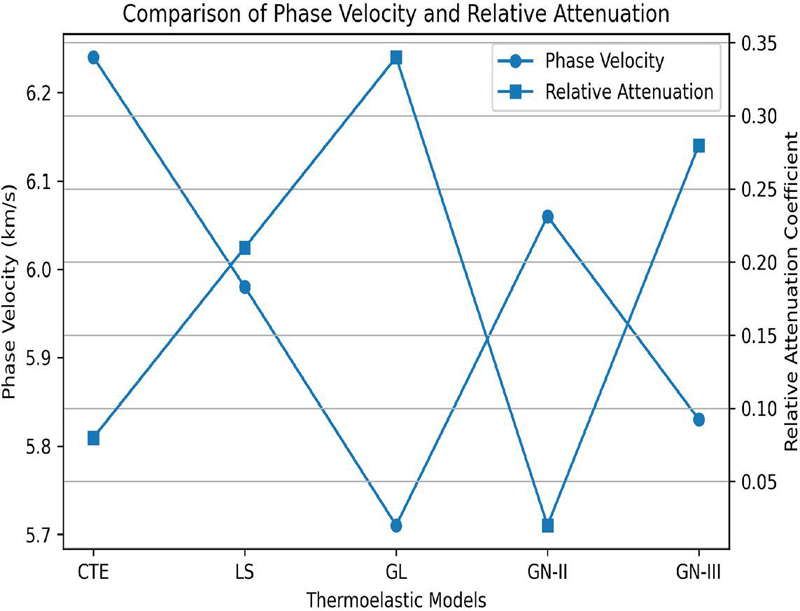
Figure 1 Graphical comparison of phase velocity and relative attenuation coefficient for different generalized thermoelastic models used in seismic wave propagation.
These illustrative comparisons support the theoretical interpretation of thermoelastic model applicability for seismic wave propagation under high-frequency thermo-mechanical conditions.
Table 3 Critical comparison of generalized thermoelastic models
| Model | Major Advantages | Main Limitations | Suitable Applications |
| Classical Thermoelasticity | Simple formulation, easy analytical treatment | Infinite thermal wave speed, unrealistic at high frequency | Low-frequency thermoelastic problems |
| Lord-Shulman | Finite thermal propagation, simple relaxation mechanism | Single relaxation parameter may oversimplify complex materials | High-frequency seismic wave analysis |
| Green-Lindsay | More realistic thermo-mechanical coupling using dual relaxation times | Additional parameters require calibration | Deep Earth and geothermal applications |
| GN-II | No energy dissipation, mathematically elegant | Unrealistic for attenuating seismic media | Fundamental theoretical investigations |
| GN-III | Finite thermal propagation with dissipation, physically realistic | Higher mathematical complexity | Advanced seismic and geophysical modelling |
The comparison presented in Table 3 demonstrates that no generalized thermoelastic theory is universally superior for all seismic applications. Instead, the selection of an appropriate model depends upon the physical characteristics of the problem under consideration.
3.6 Thermoelastic Body Waves
(a) P waves (Compressional Waves) involve volumetric deformation and are governed primarily by the dilatational potential , where
the governing wave equation becomes:
| (23) |
where
In thermoelastic media coupling with the heat equation produces two dilatational waves: Elastic P waves and Thermal waves
(b) SV waves (Vertical Shear Waves) involve vertical shear motion in the propagation plane whose displacement components:
The governing wave equation becomes:
| (24) |
where
Thermal coupling is weak because pure shear motion does not produce volume change (). However, in layered or anisotropic thermoelastic media mode conversion with P waves can generate temperature variations.
(c) SH waves (Horizontal Shear Waves) are horizontally polarized shear waves with:
They satisfy a decoupled wave equation:
| (25) |
In isotropic thermoelastic media SH waves are not directly affected by thermal coupling due to zero dilatation.
3.7 Thermoelastic Surface Waves
(a) Love type Thermoelastic Waves [24, 25] propagate in layered media and involve SH motion only. In thermoelastic media they remain weakly coupled with temperature. Thermal effects influence them indirectly via changes in elastic moduli with temperature with displacement components:
the governing equation becomes:
| (26) |
and the dispersion relation [26] depends on:
| (27) |
where is layer thickness and are vertical wave numbers in respective layers.
(b) Rayleigh type Thermoelastic Waves [27, 28] result from the coupling of P and SV waves at a free surface with displacement components,
the governing equation for longitudinal displacement coupled with temperature :
| (28) |
and governing equation for shear displacement which remains independent of temperature in isotropic media:
| (29) | |
| (30) |
this represents the heat conduction equation coupled with the rate of mechanical dilatation at boundary conditions
In thermoelastic theory an additional condition is imposed:
| (31) |
Thermal effects modify phase velocity, attenuation characteristics and dispersion relations.
3.8 Thermoelastic Effects on Seismic Waves
Thermoelastic coupling alters seismic wave behavior in a model dependent manner rather than producing uniform corrections to classical elasticity. Compressional waves experience stronger thermoelastic interaction because volumetric strain directly couples mechanical deformation with thermal disturbance generation. Consequently, attenuation and phase velocity modification become more pronounced in P-wave propagation. Shear dominated waves exhibit weaker direct coupling because pure shear deformation does not generate significant volumetric thermal effects. However indirect coupling may emerge through mode conversion, anisotropic material response, or layered boundary interactions. The incorporation of thermal relaxation fundamentally changes wave propagation behavior. Classical thermoelasticity predicts immediate thermal redistribution, whereas generalized models introduce delayed thermal response, generating frequency-dependent dispersion and more realistic attenuation mechanisms.
Among the generalized models, dissipative theories provide better representation of realistic seismic energy loss whereas non-dissipative formulations primarily serve theoretical benchmarking purposes. Thus, thermoelasticity introduces not merely qualitative modification but also measurable physical differences in seismic wave propagation dynamics.
Thermoelastic effect on body waves
(i) Show measurable attenuation at high seismic frequencies.
(ii) Important in deep crust where temperature gradients are significant.
(iii) SH waves are less sensitive (pure shear, weak thermal coupling).
(iv) SV waves are moderately affected.
(v) Attenuation smaller compared to P waves.
Thermoelastic effect on surface waves
(i) Strong dispersion
(ii) Enhanced attenuation due to surface thermal gradients
(iii) Higher sensitivity to thermoelastic parameters
(iv) Rayleigh type waves show greater damping than Love type waves due to volumetric motion components.
4 Mathematical Model for Thermoelastic Seismic Wave Propagation
Generalized thermoelastic framework is adopted to describe seismic wave propagation in elastic solids [29, 30] subjected to mechanical and thermal coupling. The formulation is particularly relevant at high frequencies where classical elasticity and Fourier heat conduction may not adequately capture thermo-mechanical interactions.
(a) Homogeneous thermoelastic medium [31] is characterized by the constant material properties such as density , Lamé constants , thermal expansion coefficient , specific heat , and thermal conductivity .
The governing equation consist of equation of motion:
| (32) |
Constitutive thermoelastic relation:
| (33) |
where
displacement components
strain tensor
temperature increment
| (34) |
Heat conduction equation for non-Fourier models:
| (35) |
Here is the thermal relaxation time. When , the classical Fourier model is recovered.
(b) Layered thermoelastic medium [32] in Earth models where material properties vary piecewise along depth . Each layer satisfies:
| (36) |
Interface conditions at :
Continuity of displacement:
| (37) |
Continuity of traction:
| (38) |
Continuity for temperature and heat flux is:
| (39) |
the configuration is essential for modelling surface waves in thermoelastic layered media.
(c) In anisotropic thermoelastic medium where the stress-strain relation becomes:
| (40) |
where are elastic stiffness coefficients e.g. in transversely isotropic Earth layers (common in sedimentary basins), wave velocities depends upon direction of propagation significantly influencing both dispersion and attenuation.
(d) Initial Stress and Temperature Field Assumptions where the medium is assumed to be initially at uniform temperature , static initial stress (often hydrostatic) and small perturbations due to seismic disturbances are superimposed:
Linearization is performed under the assumption:
This ensures mathematical tractability while retaining thermoelastic coupling.
5 Important Advances to Thermoelastic Wave Theory
The whole study helps us about the theoretical premise of thermoelastic wave propagation in the following ways:
• Propagation of thermal waves with finite effect states that the replacement of the traditional parabolic paradigm of heat conduction with a more realistic hyperbolic model ensures the physical reality of the finite speed of thermal waves.
• Dispersion relation says that explicit derivation of complex wave numbers is used to explain how the attenuation and phase velocity decreases with frequency.
• Characterization of attenuation mechanisms enables examination of thermoelastic damping near characteristic thermal relaxation frequencies.
• In geological conditions extension the pre-existing stress fields and anisotropy provides the theory with a characteristic of tectonically stressed crustal and mantle rocks.
These developments extend the theoretical framework of thermoelastic wave propagation beyond conventional damping models which is no longer restricted to the phenomenological theory of damping and the value of attenuation into seismic waves that can be attributed to the thermodynamic consistency.
6 Conclusion
The present study provides a comprehensive generalized thermoelastic framework for investigating seismic wave propagation in solids whose material is thermo mechanically coupled. The proposed formulation includes thermal relaxation a finite speed (spatial) heat conduction and strain temperature decoupling as opposed to classical elastic model where the effects of temperature were neglected. The methodology establishes a conceptual relationship between classical elasticity and through stepwise approximation, superior thermoelastic theories that are paramount to the modelling of high frequencies seismic seismicity in a realistic sense.
• Finite thermal wave speed: The generalized thermoelastic theory replaces the classical parabolic heat equation, it may be seen as including hyperbolic or mixed type equations as well, rendering any signal propagation thermal effects finite and restoring causal behavior to high frequency seismic waves.
• Thermal relaxation time effects: Experiments since the LS and GL models balance the dynamic attenuation of the effect of delayed heat flow, we expect that they exhibit a delayed response to heat flux that entirely changes the wave attenuation and the phase speed near characteristic relaxation frequencies.
• Real frequency dependence dispersion: It can be encapsulated in frequency dependent dispersion with explicit frequency dependence of phase velocity and attenuation which is commonly strongest in frequencies corresponding to high frequency seismic waves and in source regions.
• Multiple dilatational wave models: A longitudinal motion splits into elastic and thermal wave modes and the wave spectrum is now enriched by more than elasticity based classical wave models.
• Surface wave modification: Rayleigh type waves are severely modified by thermoelastic effects through coupled P-SV motion and surface thermal basic conditions whereas SH type waves are only significantly perturbed in isotropic media.
• Entropy and energy consistency: The formulation satisfies thermodynamic admissibility to entropy production inequalities and energy functional construction and mathematical well-posedness.
• Reduction to classical theory: The generalized theory is reduced to classical thermoelasticity in the limit of relaxation times going to zero and provides a consistency check of the method by consistent limiting cases.
6.1 Limitations of the Present Study
Although the present study provides a structured comparative theoretical assessment of generalized thermoelastic formulations for seismic wave propagation, certain limitations should be acknowledged.
The present investigation is primarily theoretical and comparative in nature without full scale numerical solution of the governing coupled thermoelastic wave equations derived for each model. While illustrative comparative numerical trends have been included to demonstrate relative physical behavior, exact equation based computational validation would further strengthen the predictive rigor of the analysis. The analysis focuses mainly on generalized isotropic thermoelastic formulations and conceptual seismic environments. More realistic Earth conditions involving strong anisotropy, heterogeneous layered crustal structures, nonlinear thermo mechanical coupling and complex source mechanisms require further dedicated investigation.
These limitations provide clear directions for future numerical, experimental and application oriented research.
7 Physical Implications and Applications
Recent studies on thermoelastic surface wave propagation in layered and irregular geological media further support the practical importance of generalized thermoelastic formulations for geophysical applications. These investigations suggest that thermo mechanical coupling materially affects attenuation, dispersion and interface wave characteristics particularly in high temperature and structurally complex environments.
The findings have significant implications on the modern seismology:
• In the intrinsic attenuation mechanism the thermoelastic coupling provides another physical account on amplitude decay on top of that of geometric spreading and viscous damping.
• Into high frequency seismic behavior, the above frequency, dispersion and damping play an important role (especially the body wave being recorded very near the seismic sources).
• In deep Earth environments, elevated temperatures enhance thermoelastic coupling, and it in turn alters quantity and quality factors of waves in geothermal and mantle environments.
• Surface wave sensitivity in Rayleigh type waves contain more thermoelastic modification than purely shear Love type waves because of the volumetric strain components.
• Better hazard modeling for frequency dependent damping affects predictions in spectral acceleration and high frequency and ground motions.
Thermoelasticity is not only a secondary correction that may occur but also it is a primary mechanism by which seismic wave propagates under conditions of high temperature and rapid loading.
References
[1] Dahlen, F. A., and Tromp, J. (1998). Theoretical global seismology. Princeton University Press.
[2] Shearer, P. M. (2009). Introduction to seismology (2nd ed.). Cambridge University Press.
[3] Aki, K., Christoffersson, A., and Husebye, E. S. (1977). Determination of the three-dimensional seismic structure of the lithosphere. Journal of Geophysical Research, 82(2), 277–296.
[4] Milne, J. (1898). Seismology. London, UK: Kegan Paul, Trench, Trübner & Co.
[5] Oldham, R. D. (1906). The constitution of the interior of the Earth. Quarterly Journal of the Geological Society of London, 62, 456–475.
[6] Lehmann, I. (1936). P’. Publications du Bureau Central Séismologique International, 14, 87–115.
[7] Jeffreys, H., and Bullen, K. E. (1940). Seismological tables. British Association.
[8] Aki, K., and Richards, P. G. (2002). Quantitative seismology (2nd ed.). University Science Books.
[9] Tarantola, A. (1984). Inversion of seismic reflection data in the acoustic approximation. Geophysics, 49(8), 1259–1266.
[10] Shapiro, N. M., and Campillo, M. (2004). Emergence of broadband Rayleigh waves from correlations of the ambient seismic noise. Geophysical Research Letters, 31(7), L07614.
[11] Reid, H. F. (1910). The mechanics of the earthquake. The California Earthquake of April 18, 1906,Carnegie Institute of Washington 16–28.
[12] Ben-Menahem, A., and Singh, S. J. (1981). Seismic waves and sources. Springer.
[13] Sharma, S., and Kumar, R. (2025). Exploring seismic phenomena: a comprehensive investigation into seismology and the dynamics of seismic wave propagation. Journal of Graphic Era University, 13(2), 439–458.
[14] Sharma, S., and Kumar, R. (2025). Analysis of love-type surface waves in an isotropic thermoelastic layer over a non-homogeneous elastic half-space with interface irregularity. (2026). Journal of the Nigerian Society of Physical Sciences, 8(2), 3231.
[15] Saini, A., and Kumar, R. (2025). Love wave propagation in an isotropic thermoelastic layer with rigid boundary lying over a non-homogeneous elastic half-space. Mathematical Methods in the Applied Sciences, 48(12), 16680–16689.
[16] Gutenberg, B. (1914). On the Earth’s core and S-wave shadow zones. Bulletin of the Seismological Society of America.
[17] Carslaw, H. S., and Jaeger, J. C. (1959). Conduction of heat in solids (2nd ed.). Oxford University Press.
[18] Biot, M. A. (1956). Thermoelasticity and irreversible thermodynamics. Journal of Applied Physics, 27(3), 240–253.
[19] Lord, H.W. & Shulman, Y. (1967). A generalized dynamical theory of thermoelasticity. Journal of the Mechanics and Physics of Solids, 15(5), 299–309.
[20] Green, A. E., and Lindsay, K. A. (1972). Thermoelasticity. Journal of Elasticity, 2(1), 1–7.
[21] Green, A. E., and Naghdi, P. M. (1991). A re-examination of the basic postulates of thermomechanics. Proceedings of the Royal Society A, 432(1885), 171–194.
[22] Green, A. E., and Naghdi, P. M. (1992). Thermoelasticity without energy dissipation. Journal of Elasticity, 31(3), 189–208.
[23] Green, A. E., and Naghdi, P. M. (1993). Thermoelasticity with energy dissipation. Journal of Elasticity, 31(3), 189–208.
[24] Love, A. E. H. (1911). Some problems of geodynamics. Cambridge University Press.
[25] Love, A. E. H. (1927). A treatise on the mathematical theory of elasticity (4th ed.). Cambridge University Press.
[26] Kumar, R., and Sharma, S. (2026). Dispersion analysis of Love-type surface waves in thermoelastic layered medium with irregular interface. Applied Physics A, 132(3), 220.
[27] Rayleigh, L. (1885). On waves propagated along the plane surface of an elastic solid. Proceedings of the London Mathematical Society, s1-17(1), 4–11.
[28] Roychoudhuri, S. K., and Banerjee, S. (1998). Rayleigh waves in generalized thermoelasticity. International Journal of Engineering Science, 36(1), 125–140.
[29] Achenbach, J. D. (1973). Wave propagation in elastic solids. North-Holland.
[30] Deresiewicz, H. (1960). The effect of boundaries on wave propagation in a thermoelastic solid. Bulletin of the Seismological Society of America, 50(4), 705–714.
[31] Sharma, S., and Kumar, R. (2025). Love wave propagation in a homogeneous thermoelastic layer over a non-homogeneous half-space with triangular irregularity. Mechanics of Solids, 60(5), 4259–4277.
[32] Ewing, W. M., Jardetzky, W. S., and Press, F. (1957). Elastic waves in layered media. McGraw-Hill.
Biographies

Sumit Mahiya is a Research Scholar in the Department of Mathematics at Chandigarh University, India. He is mathematics Graduate with an integrated M.Sc. in Mathematics from Chaudhary Devi Lal University Sirsa. His background is equipped with strong analytical and problem-solving skills, with a particular emphasis on theoretical and applied mathematics. He is currently focused on research in seismology, specifically in seismic wave propagation. His work centers on developing and analyzing mathematical models to understand wave behavior in elastic and thermoelastic media.

Ravinder Kumar is a Professor in the Department of Mathematics at Chandigarh University, India. He holds a Ph.D. in Mathematics from Maharshi Dayanand University, Rohtak, and completed his M.Phil. and M.Sc. in Mathematics from Chaudhary Devi Lal University, Sirsa. His research interests include theoretical seismology and applied mechanics. Dr. Kumar has published more than 50 research papers in reputed national and international journals and conferences. His work significantly contributes to the understanding of wave propagation in complex media, offering valuable insights into geophysical modeling and seismic analysis.
Journal of Graphic Era University, Vol. 14_2, 433–460
doi: 10.13052/jgeu0975-1416.1425
© 2026 River Publishers